

The Complete Guide to Amsterdam in Tulip Season

When to go, where to stay, and the insider things most guides skip entirely.
Here’s the thing about tulip season… the colourful fields you’ve seen in every Netherlands travel photo aren’t actually in Amsterdam. They’re 30 – 40 kilometres away, in the farming region between Haarlem and Leiden. Most people fly in without knowing that, and then spend a day feeling vaguely let down by a city that didn’t deliver what they expected. But that won’t happen to you, because I’ve got you.
I live here. And I want you to know that the real tulip season experience – the endless fields of colour, few crowds, hidden gems, and the gorgeous April golden hour light – is completely accessible. You just need to know where to actually go.
This is a complete guide to Amsterdam in Tulip Season with information on When to arrive, Where to stay, How to reach the fields without a car, Where to go when you’re with a car, Cycling routes through Flevoland that nobody in your friend group has done, and the historic steam train in Hoorn that most tourists fly home without ever hearing about. Read it, bookmark it, and share the link with your friends hoping to visit Amsterdam.
This post may contain affiliate links that help support me in creating content like this. If you make a purchase using one of these links, I may receive a compensation at no extra cost to you. Read my disclaimer for more information.
When to Come: Getting the Timing Right
Nature is unpredictable, but Tulip season in the Netherlands typically runs from late-March through mid-May, but there’s a peak window inside that window and getting it right is the difference between full bloom and a field of dead stems.
Mid-April Is the Sweet Spot
Mid April (15–25): This is when Keukenhof is in peak season, the Bollenstreek bulb fields are at their fullest, flowers are in full blossom on the Amsterdam canal bridges, and the light is golden until 8pm. If you can only choose one window to come, choose this one.
Early April (1–14): hyacinths and daffodils are peaking, tulips are just coming in, and it is less crowded everywhere, including Keukenhof. If queues bother you more than slightly imperfect blooms, this is the perfect time for you to visit.
Late April into May: the Keukenhof tulips would have started to fade, but the fields will still be stunning depending on the year and the variety of tulips. Amsterdam also gets warmer and sunnier, so it’s perfect to visit. King’s Day also falls on April 27 (a small note on why this is important later).
Where to Stay in Amsterdam in Tulip Season
Where you choose as your base can make or break your stay. So here’s my honest opinion.
For First-Timers: Jordaan or De Pijp
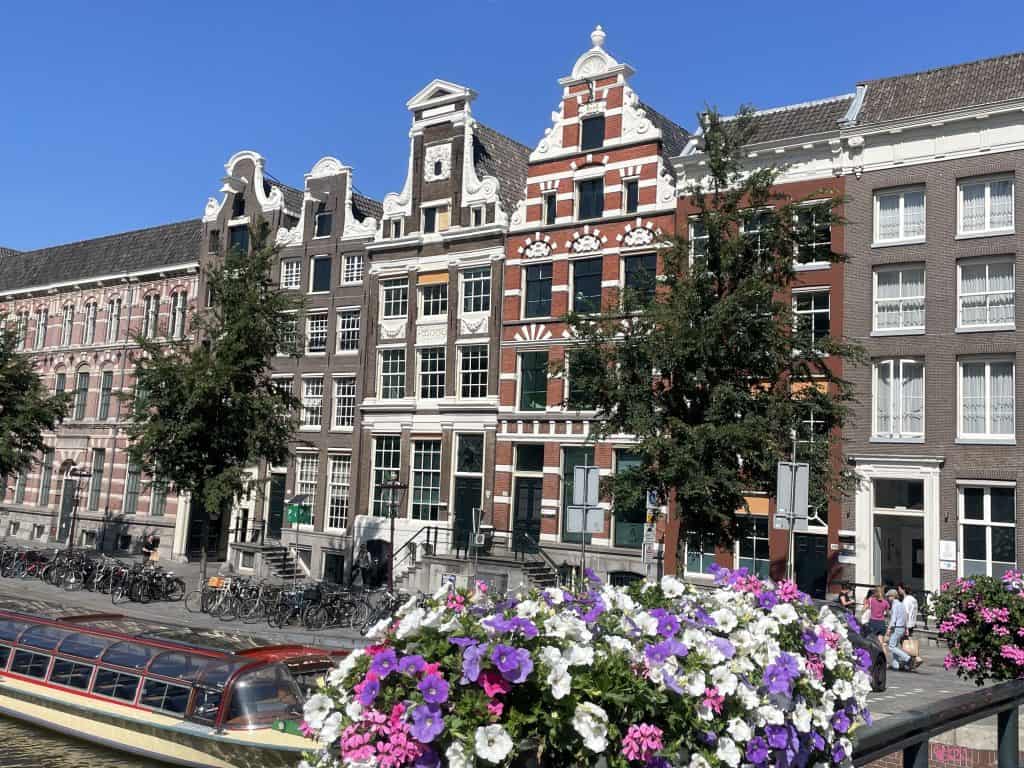
- The Jordaan is postcard Amsterdam; narrow canal houses, cozy cafes, restaurants and coffee shops (🍃), art galleries, and lots of canal side benches for lunch by the water. It’s central but not crowded, and Amsterdam centraal is walkable from here. For a first visit, this is where I’d put you.
- De Pijp sits slightly south of the centre with a more lived-in, local feeling. The Albert Cuyp Market runs through the middle of it, so you have lots of food options, and it’s more affordable than Jordaan. It’s become more touristy over the years but it still has culture.
For a Quieter Experience: Amsterdam Noord or Westerpark
- Noord is across the IJ ferry from Amsterdam Centraal Station. The ferry to cross is free, and runs every 5 minutes (night time is every 12 minutes). Because it’s a newer neighbourhood, it feels like a different Amsterdam entirely: converted warehouses, creative spaces, great coffee, almost no souvenir shops. The NDSM Wharf is here and it’s one of the coolest places in the city.
- The Westerpark area is equally good for a calmer stay. I lived here and highly recommend it. It’s residential with canal-side houses, less tourist-trap energy, and direct trams and buses to Amsterdam central. Jordaan, De Pijp & Vondelpark are also nearby for a sunny afternoon wandering. Westerpark itself also has a good mix of restaurants and hotels, so you’ll never run out of options.
What to Budget for accommodation.
Amsterdam in April is peak season. So realistic ranges are:
- Budget hotel / private apartment: €80–120/night
- Mid-range boutique hotel: €150–220/night
- Jordaan boutique: €220–350/night (and even higher)
If Amsterdam is fully booked or feels too expensive: search accommodation in Haarlem (20 mins away by train). It’s perfectly positioned for the bulb fields, so its genuinely not a downgrade.
Keukenhof: What It Is and How to Do It Right.
Keukenhof is the world’s largest flower garden, open only from late March to mid-May, and it is beautifully designed, well-maintained, and genuinely impressive when in peak bloom. Butttt this is a show garden, not the fields. So keep this distinction in mind. If you’re wondering: Yes, you should go. No, you don’t need a full day.
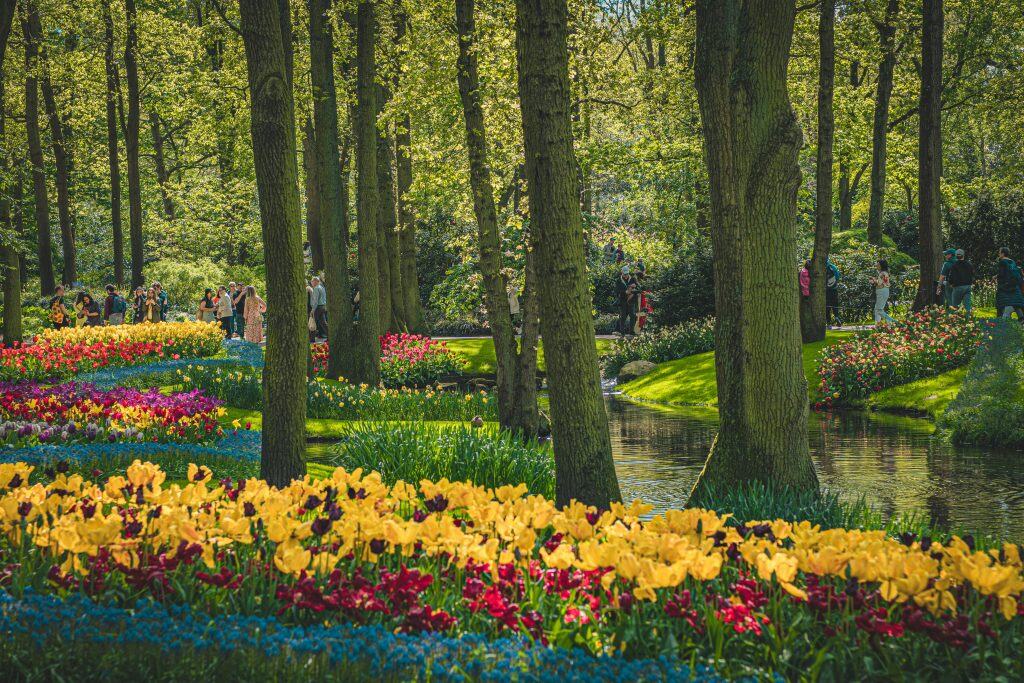
A scenic view of Keukenhof during tulip season. Photo credit: Ashis Sarker from Pexels.
The Logistics
- Book tickets online in advance at keukenhof.nl as time slots fill up, especially on weekends.
- Without a car:
- Direct buses run from Amsterdam Centraal and Amsterdam RAI (closer to Amsterdam Zuid). Check the official site each season as routes update.
- Or take the train to Schiphol or Leiden Centraal, then the Keukenhof Express bus.
- Buy the bus and entry combo ticket as it’s simpler and mostly cheaper than buying separate.
- Opening hours: typically 8am–7:30pm. Arrive at the first entry slot. Seriously.
- If you’re taking the bus, aim to go early. I typically see long lines of people waiting to get on the bus as early as 7am.
How Long Do You Actually Need?
Two to three hours covers the whole garden at a relaxed pace. Four if you love photography. It’s well-designed and not overwhelming so you can see everything without rushing, which is actually part of what makes it good.
The Part Most Guides Don’t Tell You
The endless tulip field images you have in your head (with rows of colour stretching to the horizon) are not inside Keukenhof. They’re on the roads of the Bollenstreek, the farming region outside the Keukenhof garden gates or other farms. And here’s the important nuance: the production fields themselves are private farms, and walking into them isn’t allowed because this is the livelihood of the farmers, and foot traffic can spread disease and damage crops. So it’s important to respect that.
But you’re not stuck on the roadside either. A handful of farms in the region have specifically opened their land to visitors, and these are genuinely worth knowing about. Remember to make reservations before going there:
- The Tulip Barn (Hillegom):
- 8 minutes by bike from Keukenhof
- you can wander freely, take as many photos as you want, and
- there’s a greenhouse restaurant and terrace on site.
- De Tulperij (Voorhout)
- 15 minutes by bike from Keukenhof
- An authentic working farm with a show garden, picking garden, and guided tours led by the grower himself.
- Tulip Experience Amsterdam (Noordwijkerhout):
- 8 minutes by bike from Keukenhof
- another visitor-friendly farm,
- worth combining with a Keukenhof visit since they’re in the same region.
Without a Car: Day Trips That Are Worth Your Time
The Netherlands has some of the best public transport in Europe. You can reach almost everything by train, and the ones you can’t, you can reach by bike.
-
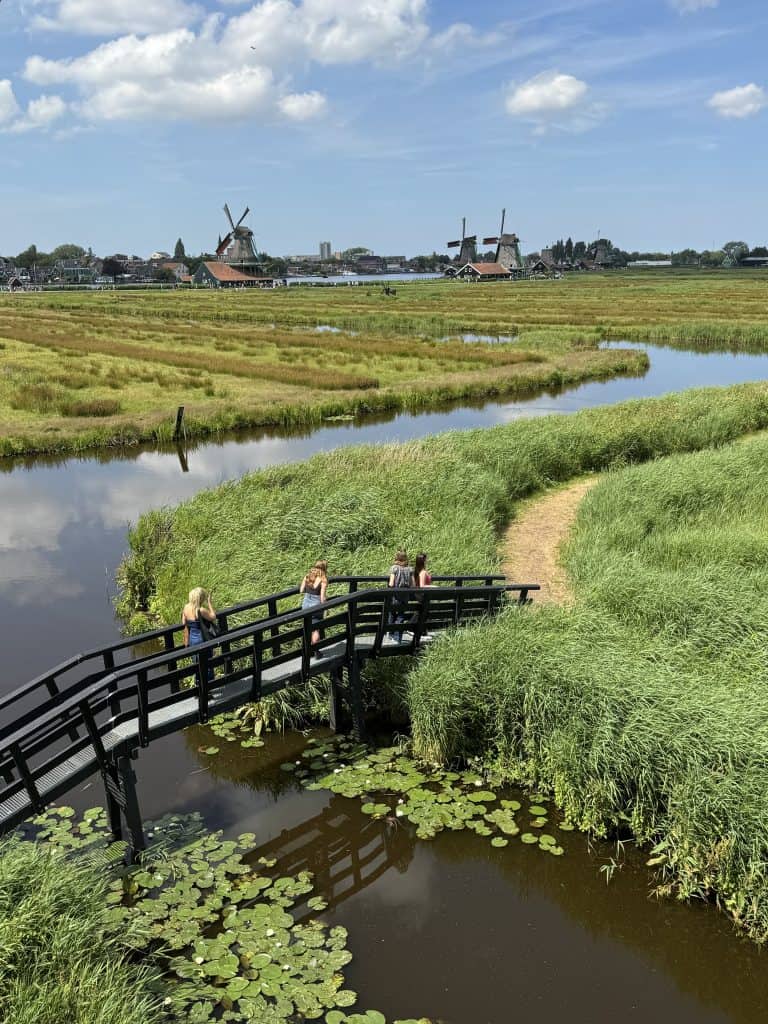
- Polders and Windmills at Zaanse Schans
-

- Zaanse Schans
Haarlem
20 minutes by train from Amsterdam Centraal (€5–6 one-way, and runs every 10 minutes), and for spring specifically, this might be my favourite day trip. Smaller and calmer than Amsterdam, Haarlem lies on the edge of the Bollenstreek. From the station you can rent bikes and cycle into the fields (1hr) or the train & bus to the fields. How to combine with Keukenhof: take the morning train to Haarlem, cycle through the bulb field roads, continue to Keukenhof by bike or bus, then back to Amsterdam in the evening.
Leiden
35 minutes by train (€12 one-way). A university city with beautiful canals and museums like the Rijksmuseum van Oudheden which has a real Egyptian temple inside it (sounds like a lie but isn’t 😁) and it’s at the southern edge of the Bollenstreek. The Keukenhof Express bus runs from Leiden Centraal during the season, making it easy to do Keukenhof in the morning and explore Leiden in the afternoon.
Zaanse Schans
About 20 minutes by train to Zaandijk, then a 15 minutes walk, OR a direct bus from Amsterdam Centraal. You’ll find post-card worthy windmills here. It’s touristy, yes, but the windmills are real and some are open to visit. Go early before 10am on weekends as it gets busy. The surrounding landscape in spring is green, colourful and very calming. You might have seen pictures of Zaanse Scans windmills with tulip fields, these are photoshopped to look that way, so keep this in mind when visiting, there are no tulip fields at Zaanse Scans. There are no tulip fields
Hoorn and the Historic Steam Train
This is the one most tourists completely miss, and it’s one of the best things I recommend.
Just 35 minutes by train from Amsterdam, this is a beautifully preserved 17th-century trading town on the IJsselmeer. In Hoorn you’ll find the old harbour, the Rode Steen square, the Westfries Museum, and the Museumstoomtram.
About the Museumstoomtram: This is a fully operational historic steam train that runs from Hoorn to Medemblik along the IJsselmeer coast. It still has the original carriages, and takes you through the scenic Dutch landscape with windmills and spring fields out of your window. From Medemblik, you can also take the historic steamboat to Enkhuizen and then a train back to Amsterdam.
- Book at https://www.stoomtram.nl/ it runs April through October.
- Look into the Steam train and boat combo, it costs more, but is worth it for the full experience.
- Hoorn to Medemblik by train takes a little over an hour.
- In peak spring, you pass through Tulip fields and sometimes they stop for pictures by the fields. It is quite the sight.
If you only do one day trip from this list, make it Hoorn with the steam train. It’s a completely hidden gem and you’ll hear people say ‘Oh I had no idea the Netherlands was like this.’ because it’s not on most itineraries.
With a Car: What Opens Up
A car (or a rental for one or two days) changes the tulip season experience significantly. The bulb fields, the coastal towns, and the Flevoland cycling routes all become more accessible.
The Bollenstreek Driving Route
The Bollenstreek (the bulb district) runs roughly 30km between Haarlem in the north and Leiden in the south. Driving it in mid-April means pulling over whenever you find a field worth photographing, and taking the smaller roads through Hillegom and Lisse. This is the Netherlands in bloom without a queue or an entrance fee.
A day that works well: start your morning from Haarlem, drive through the fields via Hillegom and Lisse, visit Keukenhof mid-morning (pre-booked), continue through Noordwijkerhout to the coast, and then late afternoon at Noordwijk aan Zee for golden hour on the beach (only if its a sunny day, the Netherlands winds are no joke in spring). Add stops in between based on what interests you.
Flevoland: The Cycling Routes Nobody Talks About
Flevoland is the Netherlands’ newest province, and it has minimal car traffic on most of its the inside roads. In April, the agricultural areas include large commercial tulip fields that most tourists have no idea exist. Drive to Lelystad (about 60km from Amsterdam, find easy parking near the station or Bataviastad), rent a bike, and cycle toward the Oostvaardersplassen nature reserve. Loop back through the agricultural areas where you’ll pass tulip fields. They are every bit as beautiful as the Bollenstreek, with none of the crowds. On the weekdays in Flevoland, you can cycle for hours and barely see another tourist. This is the version of the Netherlands that will feel like a genuine discovery. Now even if you can’t cycle (like me 🙈), you’ll also find driving routes. On the official Flevoland site, you will find a map showing both driving and cycling routes.
Texel Island
If you have a car and two days, take the ferry to Texel. Drive to the terminal at Den Helder (about 90 minutes from Amsterdam), ferry across, and you’re on the largest of the Wadden Islands. Texel has its own tulip fields in spring, and an extraordinary nature reserve called De Slufter where the sea and land blur into each other. You’ll also find many car-free cycling paths through dunes and forest.
Getting Around Amsterdam
Renting a Bike in Amsterdam in Tulip Season
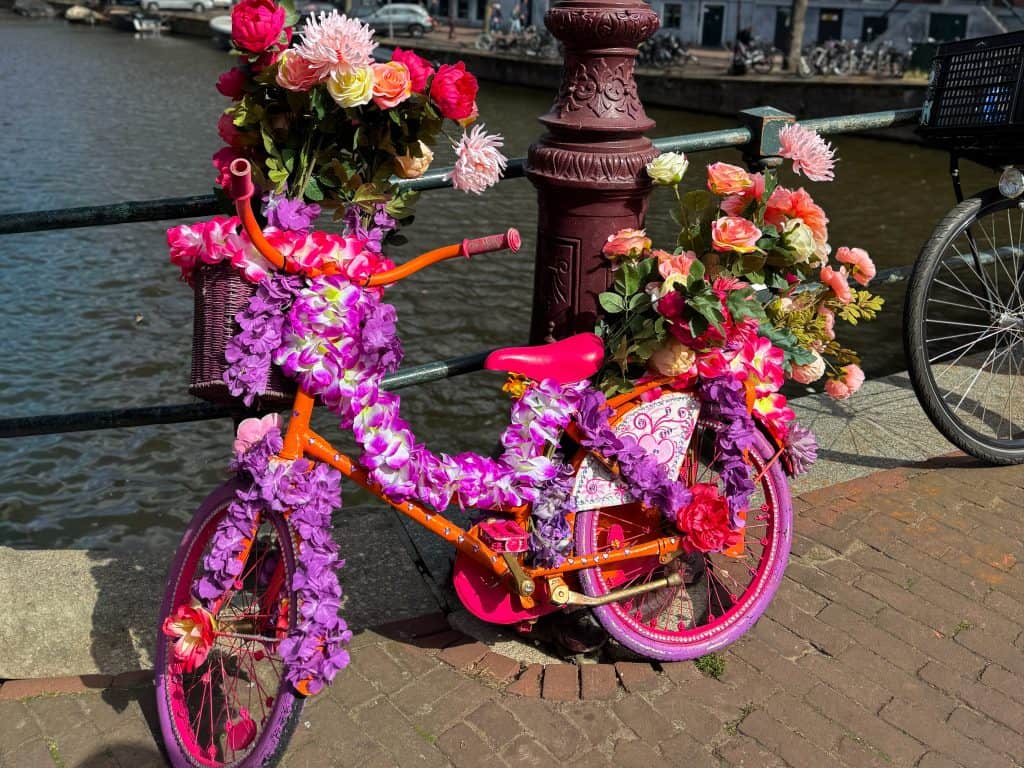
You can find flower bikes like this scattered around the city center.
Amsterdam is a cycling city (it has more bikes than people) and experiencing it on foot while everyone else cycles past you means missing a large part of what makes it feel like Amsterdam. Bike rental runs from €11/day. MacBike and Rent-a-Bike are the most central options; We Bike Amsterdam is also nice if you want a bike tour.
A few rules that matter:
- always use the designated bike lanes,
- lock your bike properly every single time (theft is very common),
- signal with your hand in the direction you’re turning,
- and if you’re a pedestrian, stay out of the bike lanes. Cyclists get really mad when you’re in their lane.
Public Transport
Tapping with your bank card works very well on all Amsterdam trams, metro, and buses and is the easiest option. Remember to always tap out as well, else it charges you a max of about €12. You can also buy tickets at the train stations, online or directly from the tram or bus driver. Tram lines 2, 11, and 12 cover the main tourist areas. Download either of these app: 9292 or NS-app to see up-to-date routes and buy tickets.
The Free Ferry to Noord
From behind Centraal Station, the free IJ ferry crosses to Amsterdam Noord every few minutes, and takes 5 minutes. Noord is worth a visit: the A’DAM Tower observation deck has a swing that hangs over the edge, the EYE Film Museum has a beautiful waterfront terrace, and the NDSM Wharf has street art and creative spaces. I linked tours so it’s easy to find.
Dutch Food You Have to Try
Some might be touristy, but are actually good and worth the hype.
- Stroopwafels: get it fresh from a market stall, then put it over your coffee cup to warm it up as the locals do. The ones in supermarket packaging are fine, but the ones made fresh in front of you are a different thing entirely especially with toppings. Note that it is quite sugary though, so a sugar rush will be imminent.
- Haring (raw herring): buy from a street cart, with raw onion, the traditional way. It has quite a strong fishy smell, so be warned in advance. It should cost €3–4 and be eaten standing up. If someone is charging €15 for it in a restaurant, walk away.
- Poffertjes: tiny fluffy pancakes, best bought at a market stall with butter and powdered sugar. As a pancake lover, this is my favourite.
- Bitterballen & Croquette: deep-fried croquette balls that have a vegan variant. The small balls are a standard bar snack, while the bigger croquette is typically eaten with bread. I always see locals get excited over these two snacks. Get them with mustard sauce.
- Kibberling: deep fried cat fish fillet, it’s a favourite with the locals as well, and you’ll likely find a line at the good stalls. I recommend an accompanying cocktail sauce, but there are usually other options as well.
- Jenever: Dutch gin, served in a small glass at a traditional bruine kroeg (brown cafe). Not my cup of tea, but if you love gin, don’t miss this.
The Albert Cuyp Market in De Pijp is the best single spot for stroopwafels, fresh herring, poffertjes, and the general market chaos that makes Amsterdam feel like Amsterdam. Go on a weekday morning if you don’t want crowds.
Insider Things to Know
The Flower Canal Cruise in Amsterdam in Tulip Season
During tulip season, a small number of operators run flower-themed canal cruises, usually with tulip arrangements on board and routes that go through the more beautiful canal stretches. My favourite is the Flagship Amsterdam boat tour, it’s a different & more aesthetic experience from the standard tourist boat. Together with the smaller independent operators (like Those Dam Boat Guys), these give you a much quieter version of the canal than the big company boats.
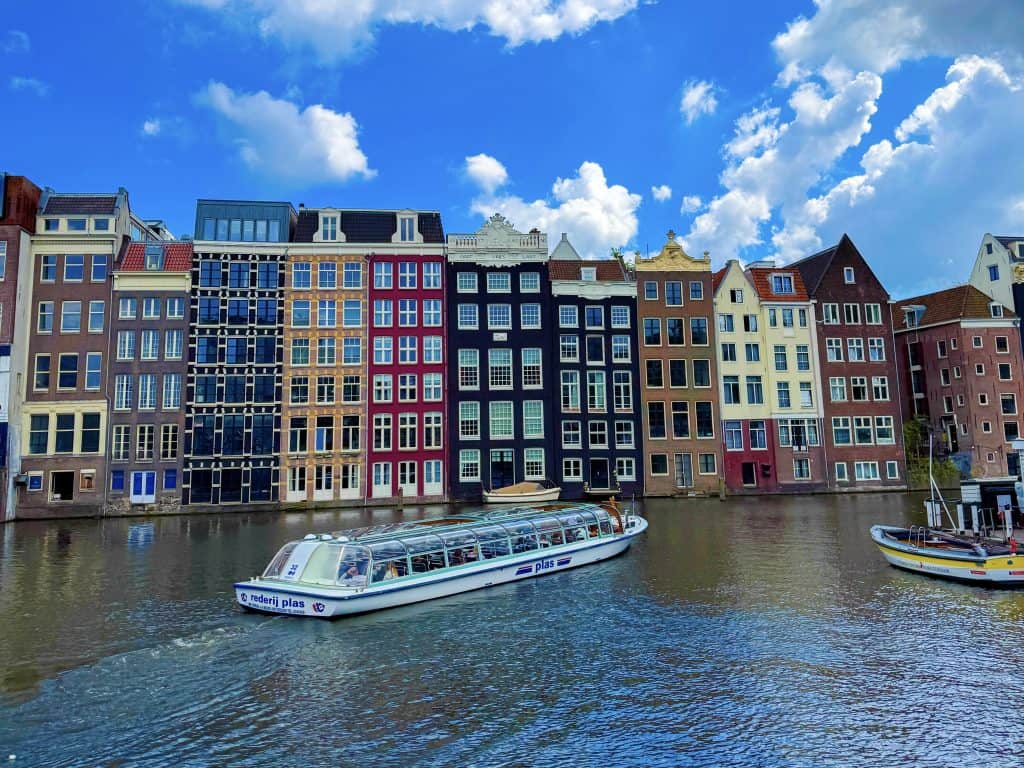
Golden Hour Is Extended
In April, golden hour in Amsterdam looks like a painting. Sunrises are my favourite as you get that red-orange glow. I’ve taken more than my fair share of sunrise photos on my way to work in Amsterdam. Sunsets are just as beautiful with the light bouncing off the canals. Use the photopills app to predict sunset and be on the Prinsengracht or Herengracht during this window. Thank me later. This is the free, no-queue, most beautiful thing the city offers, and most tourists are eating dinner.
The Noordermarkt on Sunday Mornings
In the Jordaan, the Noordermarkt hosts a Sunday farmers market alongside flowers and organic produce. It feels nothing like the Bloemenmarkt; this is more local and it shows you the local version of Amsterdam that exists underneath the tourist surface.
Mistakes Worth Avoiding in Amsterdam in Tulip Season
- Not booking Anne Frank House tickets online. You can only book tickets online, they open 6 weeks in advance and get sold out fast. So book weeks ahead at annefrank.org
- Eating on the main tourist squares (Leidseplein, Rembrandtplein). If you walk one street back, the quality and price of the food you get changes immediately.
- Assuming April means warm weather. Spoiler alert: it is very windy in spring, so bring layers and a rain jacket.
- Renting an e-bike if you’re not a confident cyclist. Amsterdam cycling traffic moves quickly and regular bikes are more manageable in tight spaces.
- Trying to do everything. It’s a busy city, so slowing down is the always right choice. One canal walk at golden hour will do more for you than five packed rushed attractions.
- Getting discouraged when it gets rainy. Find indoor activities like Fabrique des lumieres
One More Thing
Amsterdam in tulip season earns the hype – but in my opinion, this only happens if you approach it as a local would, not as a checklist. Get on a bike. Take the day trip to Hoorn. Cycle through Flevoland and watch the sky do something extraordinary over the water at golden hour.
If you’re putting together your full itinerary and budget, I have a dedicated Amsterdam spring itinerary post that goes deeper on day-by-day planning and what things actually cost. And if you’re considering timing your trip around King’s Day on April 27, be advised that on that day, the Netherlands turns into a sea of orange, it’s harder to move around and the major cities become an open air flea market. So plan accordingly.
If you have questions about anything here like the steam train booking, the Flevoland cycling routes, the best entry slot for Keukenhof, drop them in the comments. I check them and will respond
See you in the tulip fields. 🌷
— Nma